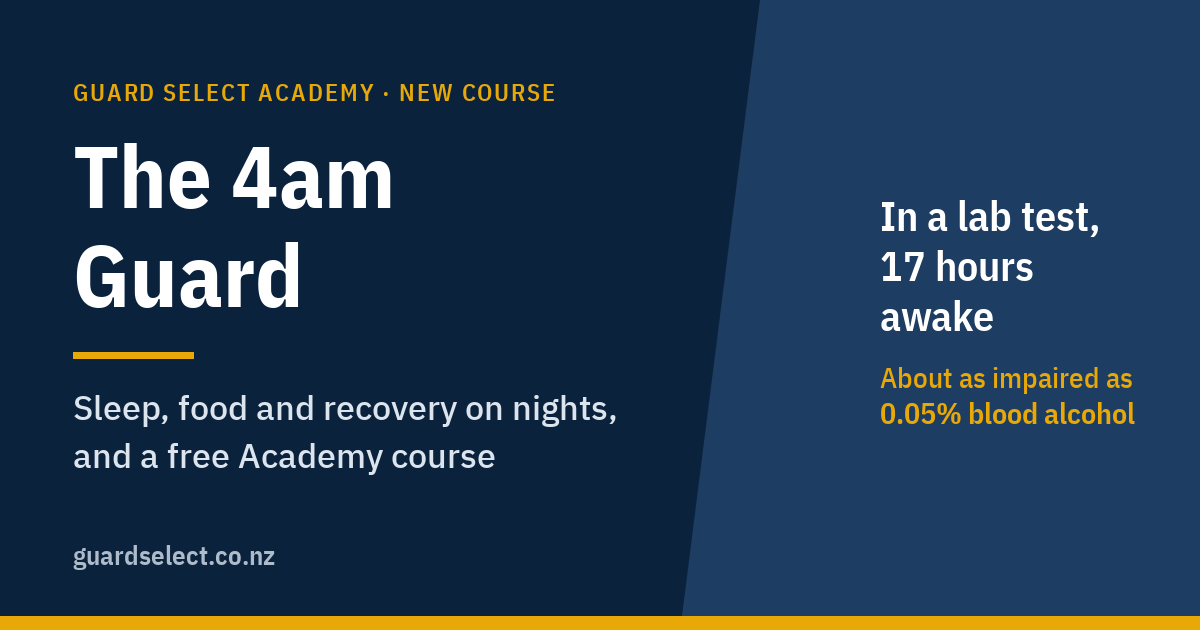
The 4am Guard: Sleep, Food and the New Fatigue Management Course
Key takeaways
- Body clocks make us sleepiest between 3am and 5am, and shift workers lose an average of 1 to 1.5 hours of sleep every 24 hours.
- In a lab test, 17 hours awake impaired performance about as much as a 0.05% blood alcohol level, New Zealand's adult driving limit.
- Guard Select's fatigue rule: at least 8 hours off before every shift and no more than 60 hours in any 7 days.
- Fatigue Management, the first Intermediate course in the Guard Select Academy, is free.
It's 4am. You've been on a static post since 10pm, and you were up at 7am yesterday. The car park is empty, the CCTV screens haven't changed in an hour, and your eyes keep sliding shut for a second at a time.
Then the radio crackles. Someone's trying the back door.
Are you the guard who started this shift, or the 4am guard?
Every guard who works nights has met the 4am guard. Slower. Shorter fuse. Fuzzier memory. In our last post we wrote about fitness and knowing your capability. This is the other half of that story: the sleep, food and recovery that decide what you're actually capable of at 4am, on the fourth night, and on the drive home.
The 4am dip is real
Your body runs on a daily clock, and night work fights it. The Ministry of Transport says our body clocks "programme us to feel at our most sleepy between 3am and 5am, and between 3pm and 5pm". WorkSafe says functioning is usually at its lowest between 3 and 5am.
The debt builds quietly, too. Healthify says shift workers lose an average of 1 to 1.5 hours of sleep every 24 hours, so four nights in a row can cost you about six hours.
Being awake a long time has a cost of its own. In a lab test, 17 hours awake impaired performance about as much as a blood alcohol level of 0.05%, New Zealand's adult driving limit. Up at 7am and still on post at midnight: that's 17 hours.
Tired is a capability problem
WorkSafe defines fatigue as "a state of physical and/or mental exhaustion… which reduces a person's ability to perform work". Its warning signs read like a list of what goes wrong on a bad night: bad moods, poor communication, poor decision-making and slower reaction times.
Mood takes the biggest hit. A review of sleep-loss studies found "mood is more affected by sleep deprivation than either cognitive or motor performance". That's your patience, your tone and your calm: the core of AWOCA and every de-escalation you'll ever do. And in a New Zealand study, people working rotating shifts that included nights had about 1.9 times the risk of injury at work.
That's why your own exhaustion belongs in your PCA. NZ Police use-of-force policy counts it as part of the assessment, weighed against the other person's size and strength. On hour eleven, the honest call is usually to keep eyes on from a safe distance, call it in and wait for backup. As NZ Police TENR guidance puts it, caution is not cowardice.
Five habits that keep you sharp
- Protect your sleep. Most adults need 7 to 9 hours in every 24, and on shift work it can come in chunks: a main sleep plus a booster nap of 40 minutes or less. Make your room dark, cool and quiet, and turn your phone off.
- Eat for the shift. Have your main meal before work, keep eating light between midnight and 6am, and have a light snack before day sleep. Pack food from home so the servo isn't your only option at 3am. Make plain water your first drink: Health NZ suggests about 8 to 10 cups of fluid a day.
- Use caffeine on purpose. FSANZ found that for adults in general, up to about 400 mg a day isn't linked to significant adverse effects, but timing matters. Healthify advises none in the 6 to 8 hours before bed, so on a 10pm to 6am shift your last coffee is due by about 11pm.
- Skip the nightcap. Healthify says alcohol "stops you getting enough of the deep sleep you need", so the after-shift beer is a poor way to come down. Stop at least 4 hours before bed, and never drink before a shift or a drive. Only time sobers you up: NZ Police say a cup of coffee, a cold shower or a good night's sleep "will not speed up the body's ability to process alcohol".
- Get home safe. In 2024, driver fatigue contributed to 19 fatal and 80 serious injury crashes in New Zealand. An Auckland study found sleepy drivers had about eight times the risk of a serious-injury crash. If you're yawning or drifting, pull over somewhere safe, take a 15 to 20 minute power nap and wait at least 10 minutes before driving on. Better still, nap before you leave or get a lift.
Balance is part of the job
Te Whare Tapa Whā, Sir Mason Durie's model, describes wellbeing as a wharenui with four walls: taha tinana (your body), taha hinengaro (your mind and feelings), taha whānau (the people you belong to) and taha wairua (your connection to the environment, people and heritage), all standing on the whenua. Shift work pushes on every wall. Protect a few anchor times each week, like a whānau meal before nights, and share your roster so your day sleep is respected.
If it's getting heavy, help is free, any time: call or text 1737, call Healthline on 0800 611 116, or call the Alcohol Drug Helpline on 0800 787 797.
Our rule, and your choice
Guard Select's fatigue rule is simple: at least 8 hours off work before every shift, including work for anyone else, and no more than 60 hours in any 7 days. The booking system checks your Guard Select hours, and you confirm the rest on every job. Because you choose your own bookings, you can build a week that works with your body: rotate forward from days to afternoons to nights, and keep 12-hour nights to two or three in a row, as WorkSafe advises.
Fatigue Management: the new Academy course
We've turned all of this into Fatigue Management: Sleep, Fuel and Balance for Security Work, the first Intermediate course in the Guard Select Academy. It's free to take.
- Seven short modules on the body clock, sleep, rosters, food and water, caffeine and alcohol, fatigue on the job, and balance.
- A 20-question final with an 80% pass mark, and retakes allowed.
- A badge, certificate, XP and points, plus +1 on your Guard Select Score.
- Built on New Zealand guidance from the Ministry of Health, Health NZ, WorkSafe, NZTA and Healthify.
It's the recovery half of the Physical Standard. The fitness test measures your engine. Fatigue Management keeps it running. Client staff can take it too, through the client Academy.
If you want to go further, a health coaching course will lift your own capability and help you look after the people around you. One option is the PreKure Health Coach Certificate, which NZQA has assessed as equivalent to 30 credits at Level 5.
Capability isn't what you can do on your best day. It's what you can do at 4am, on the fourth night, and on the drive home.
Start the Fatigue Management course in the Guard Select Academy.
General information for healthy adults, not medical advice. If you have a health condition, take medication, are pregnant, or have had trouble sleeping for weeks, talk to your GP or call Healthline on 0800 611 116. Guard Select isn't affiliated with or endorsed by NZ Police, WorkSafe, Health NZ or PreKure.
Be the change. Join the movement.
Yours faithfully,
Tarquyn Read
Founder, Guard Select
Guard Select Limited, PSPLA company licence 26-141664
Key sources
- Ministry of Transport: Fatigue (2024 crash data)
- WorkSafe: Managing the risks of shift work
- WorkSafe: Fatigue quick guide
- Healthify: Shift work and how it affects your sleep
- Ministry of Health: Meeting sleep guidelines 2024/25
- Dawson and Reid (1997): fatigue, alcohol and performance impairment
- Pilcher and Huffcutt (1996): sleep deprivation and performance
- Fransen et al. (2006): shift work and work injury in New Zealand
- Massey University Sleep/Wake Research Centre: Tips for shift workers
- Healthify: How food and drink affect sleep
- Health NZ: Drinking enough fluids
- FSANZ: Caffeine
- Healthify: Sleep and caffeine
- Healthify: Sleep and alcohol
- NZ Police (2026): The 'morning after' risk
- NZTA Road Code: Driver fatigue
- Connor et al. (2002): driver sleepiness and serious-injury crashes in Auckland
- Mental Health Foundation: Te Whare Tapa Whā
- NZ Police (2024): Use of Force Overview
- PreKure: Health Coach Certificate
Read next
More from the Guard Select blog
Book a licensed security guard in your city
Choose a COA-verified guard anywhere in New Zealand and book through Guard Select Limited, a licensed security company. No management markup: guards keep 97% of every booking.